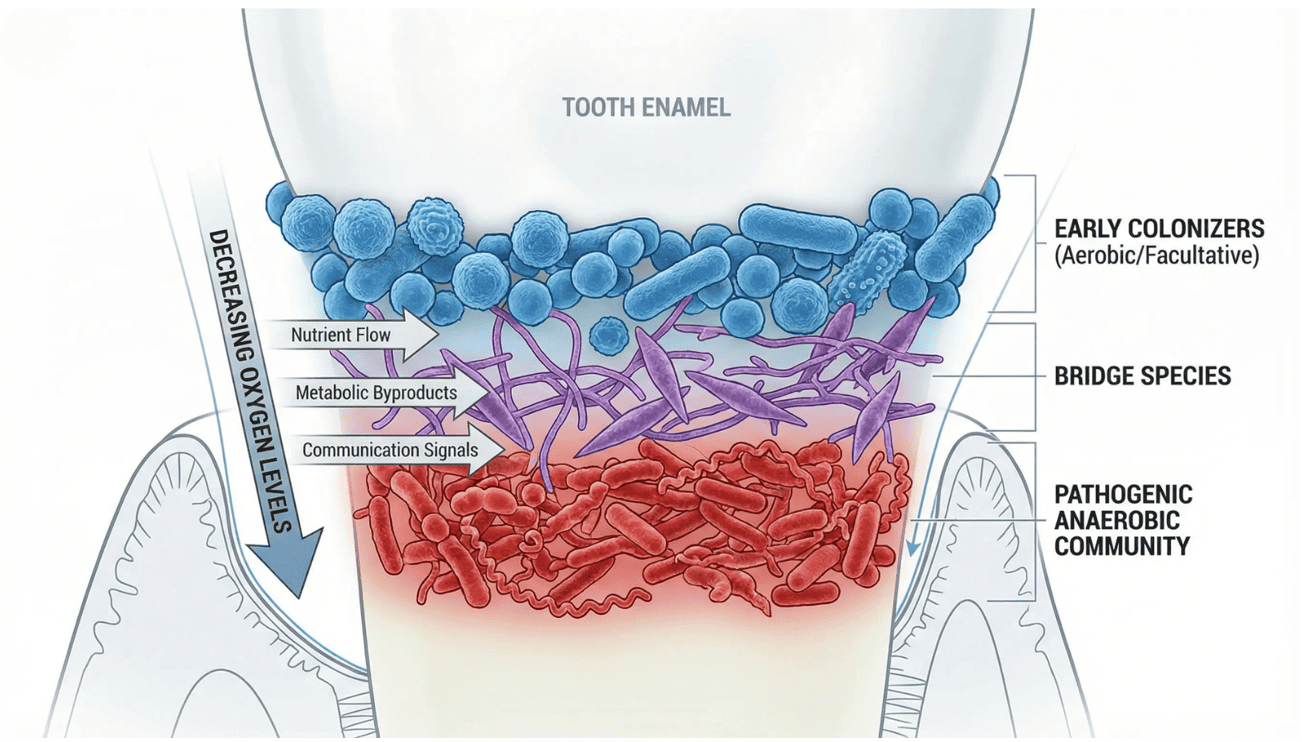
The bacteria we strive to treat is the Spirochete

Headline: Meet the corkscrew bacterium that swims into your gums and brings its own demolition enzymes
Most of the bacteria we talk about sit on a surface — on the tooth, on the tissue, in the biofilm. Treponema denticola is different, and understanding why changes how you think about a deep pocket.
Td is a spirochete — a long, corkscrew-shaped bacterium, a cousin of the organism that causes syphilis. And like its notorious relative, its shape is a weapon: Td is motile, twisting and swimming through viscous environments and into your gum tissue instead of resting on top of it. That motility isn’t a curiosity — it’s part of how Td and P. gingivalis build damage together, with Td’s movement contributing to their synergistic biofilm (Front Cell Infect Microbiol, 2019).
Once it’s in, Td brings tools. Its signature enzyme is dentilisin, a chymotrypsin-like protease that degrades the proteins holding your tissue together — extracellular matrix, fibronectin, basement membrane, and host immune factors. This is why you can see tissue breakdown at sites where the calculus load looks modest: Td doesn’t need a mountain of deposit to do harm, because it carries its own molecular demolition kit. And its major surface protein (Msp) rounds out the arsenal — it mediates attachment, forms pores, and actively disrupts immune-cell signaling so the spirochete can evade the response while it burrows (Arch Microbiol, 2024).
Here’s the systems point, and it’s the reason Td matters for the whole series: Td rarely acts alone. It’s a member of Socransky’s red complex with Pg and Tf, and the Pg–Td relationship is genuinely synergistic — together they grow better and cause more destruction than either does solo (PLoS One, 2013). That stubborn 6mm pocket that won’t close may not be a cleaning failure. It may be a partnership.
Spirochetes thrive in deep, oxygen-starved pockets, which is exactly why the tools we choose—thorough subgingival disruption, oxygenating, and antimicrobial approaches—matter, and why matching them to the target beats generic cleaning.
A pocket that won’t close is a question worth answering. Find out which bacteria are living in yours: bristlehealth.com/amber (affiliate; I only recommend what I trust). Subscribe — next week, the quiet one that eats your protective sugar coat: Tannerella forsythia.
WHAT THIS MEANS AS A PROVIDER
Td reframes the “non-responding site.” When a pocket won’t close despite good mechanical therapy and a compliant patient, the reflex is to blame technique or home care. Sometimes it’s neither — it’s a Pg–Td synergy sustaining a deep, anaerobic niche, with Td actively burrowing and dissolving attachment while dodging the immune response.
Therefore we must treat deep, refractory pockets as a microbial question, not just a mechanical one. Full biofilm disruption, oxygenation, and disrupting that low-oxygen environment are your levers — and confirming the red-complex burden tells you whether you’re winning.
Learn what’s on my periodontal formulary with Thrive Chairside (Linky)
🔒 —— Paid: The Chairside Files —— The refractory-pocket workup, the subgingival tool logic for spirochete-heavy sites (debridement, oxygenating/antimicrobial adjuncts, air polishing where appropriate — from the formulary), the re-evaluation cadence, and how a Td/Pg-positive salivary result (Bristle) tells you whether the community is actually shifting or just quiet.
WHAT THIS MEANS AS A PATIENT
If you have a deep gum pocket that keeps coming back no matter how well you brush, here’s something worth understanding: one of the bacteria involved, Treponema denticola, is a corkscrew-shaped organism that actively swims into the gum tissue and releases enzymes that dissolve the structures holding your teeth in place. It also teams up with other bacteria to make the problem self-sustaining.
This isn’t about you not trying hard enough. It’s about what’s living in that specific pocket. The path forward is thorough professional cleaning below the gumline plus, often, targeting that low-oxygen environment — and knowing which bacteria are down there so the plan can match them. Ask your hygienist about a salivary microbiome test if you have pockets that won’t heal.
CTA

Join our Thrive Chairside Summit
The Science: Msp review 2024 (Arch Microbiol) · Pg–Td synergistic biofilm 2013 (PLoS One) · Td motility synergy 2019 (Front Cell Infect Microbiol) · Socransky et al. 1998 (J Clin Periodontol).
newer POSTs +
older POSTs +
sign up now →
Ready to Transform Your Dental Career?
Take the leap and join a community of forward-thinking RDHs! With this on-demand training, you'll finally break free from burnout and unlock your true potential. Master time management, boost case acceptance, and transform your workday into a stress-free experience. You deserve to thrive!
