The Leadership Gap No One in Dentistry Talks About

You trained for years to master clinical excellence. But nobody trained you to lead people — and that gap is costing your practice more than you think.
I’ve spent years working inside dental practices, watching brilliant clinicians struggle not with cases — but with their teams. The operatory? Perfect. The relationships? Complicated. And the culprit is almost always the same: no one ever taught them how to lead.
Let me ask you something. How many years did you spend in school becoming a dentist? Eight? Ten? Eleven if you specialty trained? Now — how many hours of that time were dedicated to leading a team, building trust, or navigating the human dynamics that determine whether your practice thrives or just survives?
For most of us, the answer is close to zero.
That’s the gap. And in today’s dental landscape — with multigenerational teams, rising turnover, and a workforce that is actively seeking purpose and connection — that gap is widening.
Clinical skill gets results. Emotional intelligence sustains them.
This is why I’ve become so passionate about leadership development for dental professionals. One of the most useful frameworks I’ve found is one developed by psychologist and author Daniel Goleman: the six leadership styles. I want to walk you through all six — what they look like in a real dental practice, when they work, and when they quietly destroy the culture you’re trying to build.

First: the operating system underneath it all
Before we get into the six styles, I want to name something that underpins all of them: emotional intelligence — or EQ. EQ is your ability to recognize and manage your own emotions, and to read and respond to the emotions of others. It has four components that matter enormously in a practice setting:
Self-awareness — You know what triggers you before it shows up in the operatory. That frantic patient at 4:45pm doesn’t rattle you the same way it used to.
Self-regulation — You respond; you don’t react. Even on a hard clinical day when the schedule is imploding and the autoclave is down, you stay regulated enough to lead.
Empathy — You read your team and your patients before they say a word. You notice the assistant who’s quieter than usual.
Social skill — You build trust, resolve conflict, and inspire people without forcing compliance. This is what separates good clinicians from great practice leaders.
I also want to share a concept I come back to constantly: the Trust Equation. Trust is built on credibility (you know your stuff), reliability (you do what you say), and intimacy (you make it about them — not you). The thing that erodes trust fastest? Self-orientation. The more your leadership is about your stress, your standards, or your schedule, the less your team trusts you.
Goleman’s six leadership styles — and what they look like in your practice
Goleman’s research found that leaders who get the best results don’t rely on just one style. They read the room, and they flex. The goal isn’t to pick your favorite style and live there — it’s to become fluent in all six so you can choose the right one for the right moment.
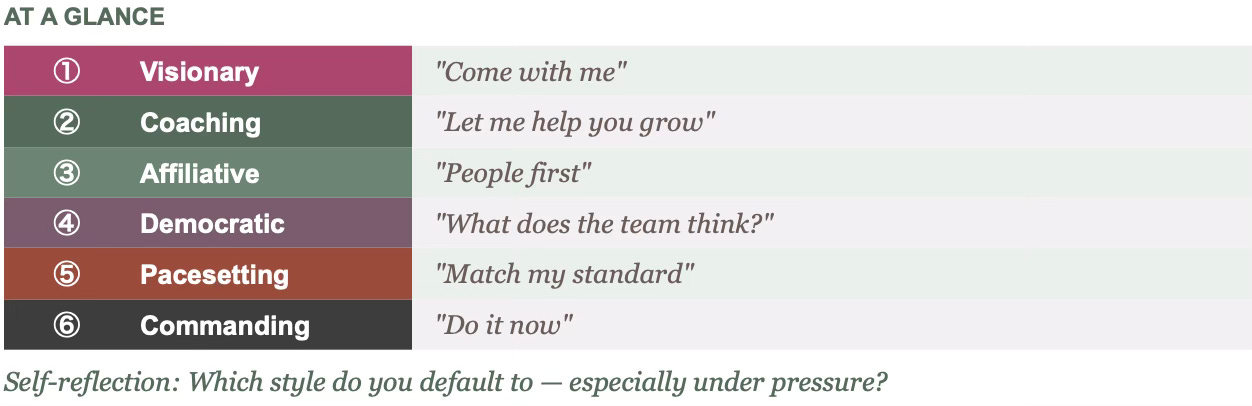
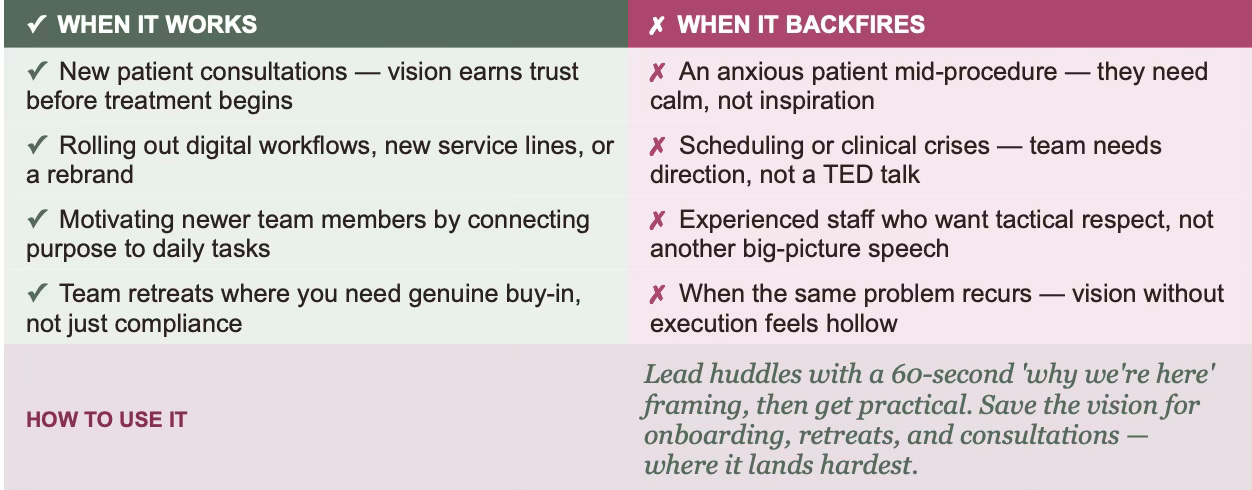
1. VISIONARY “Come with me — here’s where we’re headed.”
A visionary dentist leads with a compelling picture of what the practice is becoming. They connect the daily work to a bigger purpose — in team huddles, patient consultations, and during change. When rolling out a new system, they lead with the why before the how.
“We’re not just cleaning teeth — we’re changing how people feel about their health.”
“I want us to be the practice patients drive past three others to get to.”
2. COACHING “Try it this way — let me help you get there.”
A coaching dentist invests in growing their people over time. Rather than just correcting mistakes, they ask: ‘What do you think happened, and what would you do differently?’ They turn a front desk coordinator into a case acceptance champion — not by telling them what to say, but by developing how they think.
“Let’s debrief that patient interaction — what did you notice?”
“I want to help you get to the point where you can lead that consultation without me.”
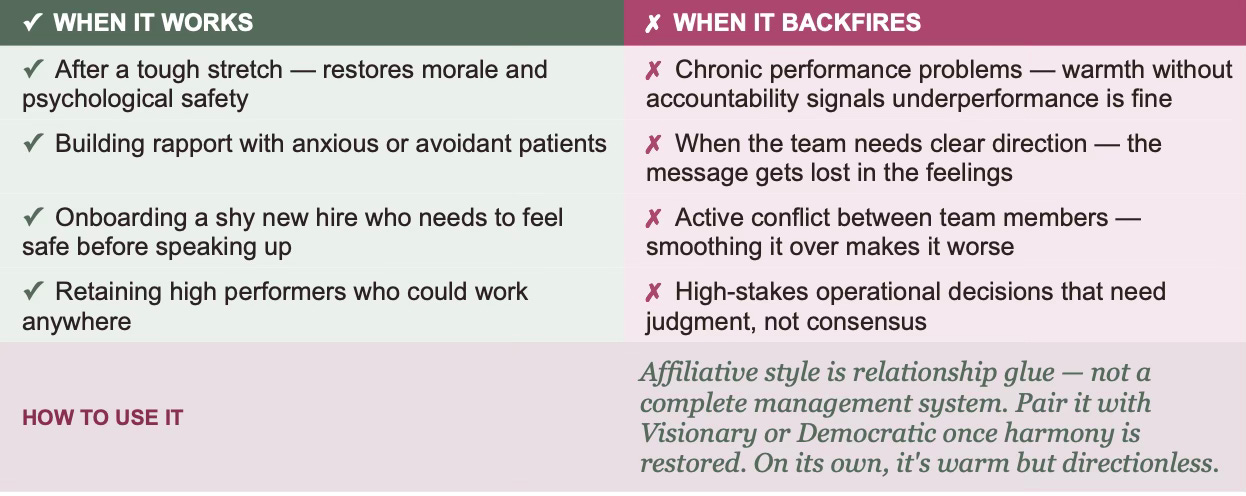
3. AFFILIATIVE “People first — harmony matters here.”
An affiliative dentist leads with emotional attunement. They notice when a team member is quieter than usual, create a culture where people genuinely like coming to work, and build the trust that gets a nervous first-timer — or a skeptical adult — to say yes to treatment.
“How are you doing — and I mean actually doing, not just at work?”
“We had a hard week. I see you all. Let’s take a breath before we open the doors.”
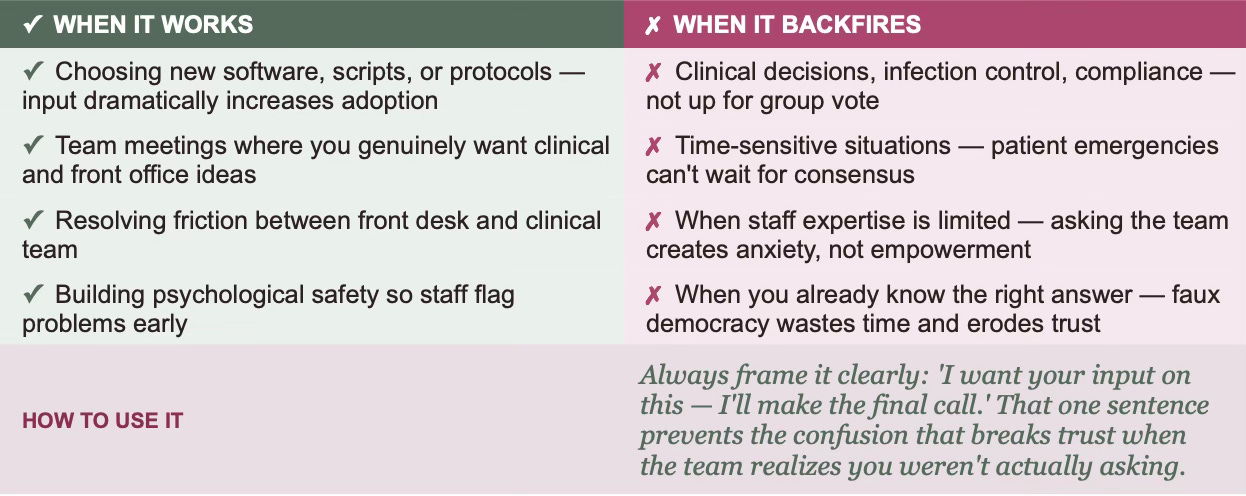
4. DEMOCRATIC “What does the team think — let’s decide together.”
A democratic dentist believes the best decisions come from the people closest to the work. They bring the team into operational decisions — scheduling systems, patient communication scripts, recall protocols — and give staff a real voice. The result: a team that owns outcomes, because they helped shape them.
“Before I decide on the new communication system, I want to hear from everyone who touches it.”
“You all see things I don’t. What’s actually slowing us down between patients?”
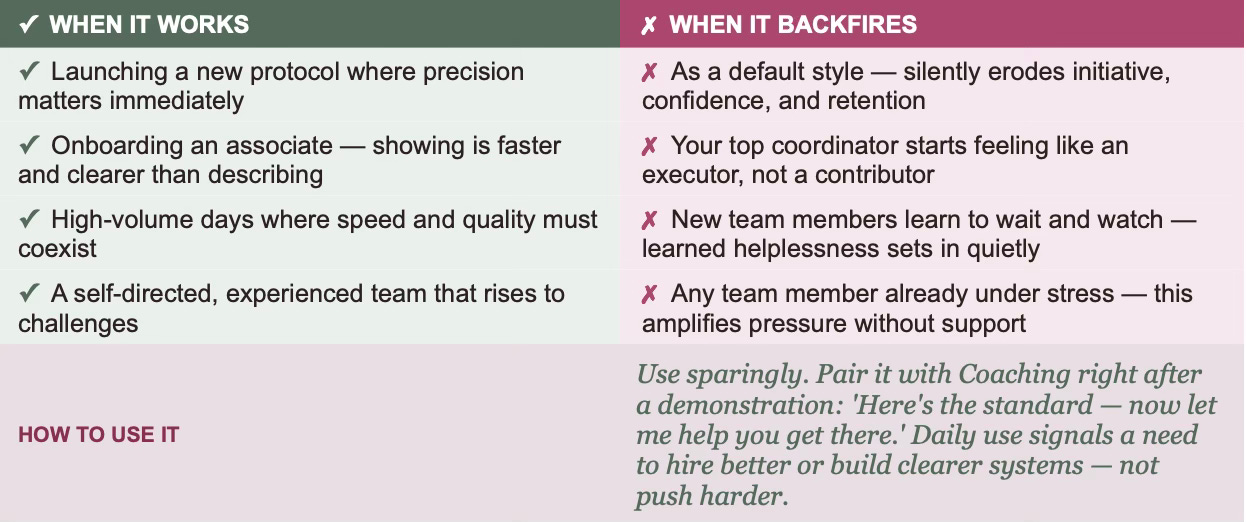
5. PACESETTING “Do it my way, fast, and at this standard.”
This is the one I need you to pay closest attention to — because it’s probably yours. A pacesetting dentist leads by doing: first in, last to leave, modeling the standard they expect. Goleman’s research found this is one of the most overused styles among high-achieving clinicians, precisely because it works in the short term — but it quietly erodes the team’s initiative, confidence, and retention over time.
“Watch how I do this. That’s the standard.”
“We don’t leave until it’s done right.”
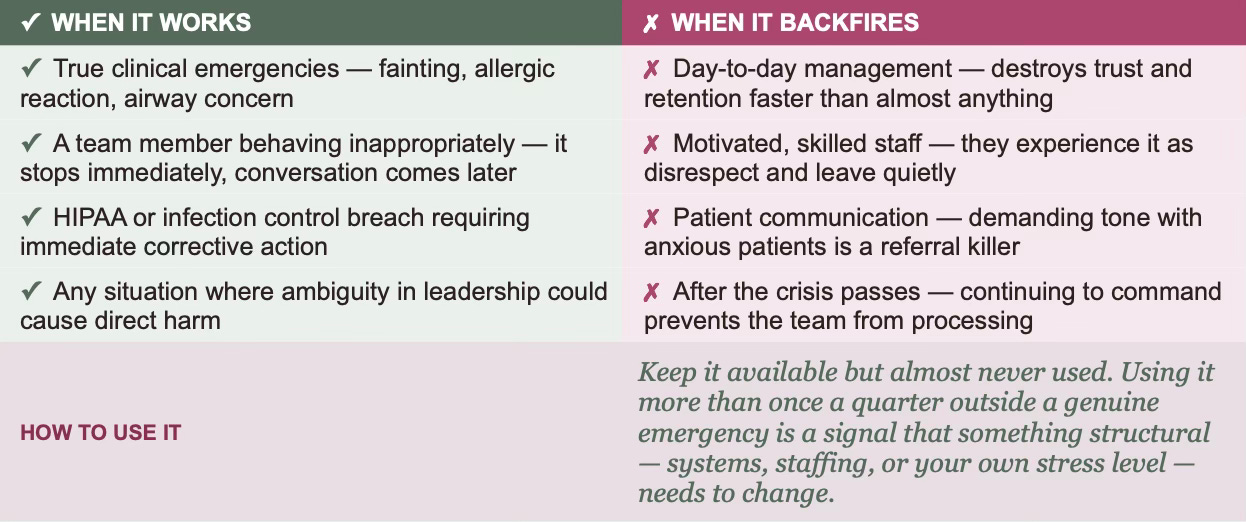
6 COMMANDING “Do what I say, right now — no discussion.”
A commanding dentist can shift instantly into clear, non-negotiable authority when the situation demands it. No ambiguity, no discussion, no consensus-seeking. In a genuine clinical emergency or compliance breach, this is exactly what the team needs — one clear voice cutting through the noise. This style is not about dominance. It’s about decisiveness when hesitation causes harm.
“Stop. Everyone out of the room. Now.”
Accountability that inspires — not intimidates
One of the things I hear most often from dentists is some version of: ‘I have high standards and my team doesn’t meet them.’ What I often find when I dig in is not a standards problem — it’s a clarity problem. Or a feedback problem. Or a consequence problem. Here’s the framework I use:
- Clear expectationWhat does ‘done right’ look like? Spell it out. Don’t assume they know. Vague standards create anxious teams — specific standards create confident ones.
- Consistent feedbackRegular, specific, two-way — not just annual reviews or crisis moments. Feedback is only effective when it’s timely and tied to a behavior the person can actually change.
- Recognition or consequenceBoth matter. Without recognition, high standards feel punitive. Without consequence, they feel optional. Accountability is an act of respect — not control.
Pacesetting without a feedback loop = high standards with no pathway. That’s not accountability — that’s pressure.
Your leadership → your culture → your patient outcomes
Here’s the connection I want you to hold onto long after you finish reading this:
How you lead shapes how your team shows up. How your team shows up shapes what patients feel in your chair. What patients feel in your chair determines whether they refer their friends, whether they accept treatment, and whether they come back year after year.
Leadership is not soft. It is one of the highest-leverage decisions you make — because everything your patients experience passes through your team first.
The practices I see thriving right now are not necessarily the most technically advanced. They are the most intentional. Their leaders know their default style. They know when to flex. They’ve built cultures where team members feel safe to grow, raise concerns, and genuinely own the patient experience.
The best dental leaders aren’t the most technically skilled. They’re the most intentional.
One thing to do before Monday
I don’t want this to be another thing you read and forget. So here’s what I’m asking you to do:
- Name your default style. Which of the six do you reach for when things get hard? When the schedule falls apart, when a team member makes an error, when you’re exhausted at 5pm? That’s your default. Know it.
- Identify one person you’ve been leading with the wrong style. Is there someone on your team you’ve been Pacesetting when they need Coaching? Someone you’ve been Affiliative with when they actually need accountability
- Make one adjustment this week — just one. Leadership doesn’t change in a workshop or a blog post. It changes in a single intentional moment. Find yours this week.
“You became a dentist to change lives — one mouth at a time. The most powerful tool you have for doing that isn’t in your operatory. It’s how you lead the people in it.”
References
- Ha JF, Longnecker N. Doctor–patient communication: A review. Ochsner J. 2010;10(1):38–43. https://pmc.ncbi.nlm.nih.gov/articles/PMC3096184/
- Schmid Mast M, Kindlimann A, Langewitz W. Reciprocal influence in doctor–patient communication: A placebo controlled study. Patient Educ Couns. 2005;57(3):333–339. https://nam.edu/perspectives/patient-clinician-communication-basic-principles-and-expectations/
- Kinnersley P et al. Interventions to promote patient-centred care in clinical consultations. Cochrane Database Syst Rev. 2015;(3):CD003267. https://glidewelldental.com/education/videos/previous-webinars/increase-case-acceptance-with-powerful-scripting
- Levin RP. Increasing case acceptance through improved communication techniques. J Am Dent Assoc. 2016;147(9):736–738. https://pmc.ncbi.nlm.nih.gov/articles/PMC12135588/
- Fiscella K, Mauksch L, Bodenheimer T, Salas E. Improving care team communication: Building shared mental models. Jt Comm J Qual Patient Saf. 2020;46(8):423–429. https://smileshopmarketing.com/resource/case-acceptance-script-training-guide/
- Mills K. Team communication in dental practices and its impact on patient perception. Br Dent J. 2018;224(8):597–604. https://www.teero.com/blog/how-to-measure-dental-case-acceptance-rate
- Levin RP. The critical role of communication skills in case acceptance. Dent Econ. 2021;111(5):38–41. https://www.drbicuspid.com/dental-practice/patient-communication/article/15752389/increasing-your-dental-case-acceptance-rate
newer POSTs +
older POSTs +
sign up now →
Ready to Transform Your Dental Career?
Take the leap and join a community of forward-thinking RDHs! With this on-demand training, you'll finally break free from burnout and unlock your true potential. Master time management, boost case acceptance, and transform your workday into a stress-free experience. You deserve to thrive!
